after a couple of days just hanging out in santa marta, enjoying serendipitous afternoon conversations with local people, i took off into the mountains again, this time just a two-hour bus ride up to a small village called minca. a german guy operated a small farm up there, and rented out the spare rooms. it was very peaceful and relaxing, and i ate a lot of delicious mangoes which were just then falling, and helped to roast and grind coffee beans and peel and boil mangoes in exchange for my room.
then, it was time finally to leave the coast and head inland.
i arrived last sunday in bogota to beautiful blue skies, and a city with a very european feel, with gleaming twingos competing politely for road space with battered renault 4s, clean streets bustling with pedestrians, and an effective if complex rapid transit system, utilising bendy buses in dedicated lanes.
the following day, i moved out of the hostel and into jason's tiny but very cosy apartment in a colonial building. since then, i have been relaxing and just enjoying being in a city of some size. it's great to wander the streets people-watching, hang out in the parks or plazas, stroll amongst the colonial architecture of the old city, or sip juan valdez coffee amongst the students who are much cooler than me. the girls are, true to reputation, beautiful. i have no idea what the crime figures actually are, but i certainly feel safer here than in any of the central american capitals, and window-shopping along carrera 7 could be in any european city. every sunday several main thoroughfares are closed to vehicular traffic, for cyclists, joggers, skaters, or just strollers.
i really like this city, and i don't think there's another one to rival it this side of buenos aires, so i am inclined to consider staying here a little while.
Friday, May 26, 2006

Monday, May 15, 2006
Hot chocolate and the charlie factory
You know, I'm really having trouble knowing where to start with this one. Three day's hard hiking brought us to the most beautiful and unspoilt ruins site I have ever seen. And the journey itself was as fascinating as the destination. Here are some of the themes of the week.
Drugs
As some of you may know, apparently some drugs are produced in Colombia. Actually, a lot of drugs. Historically, Marijuana was the crop of choice in the foothills of the Sierra Nevada, but in 1980 the Colombian government aided by the US government took a strong anti-drug stance in the region, spraying and killing all the crops. However, marijuana is still widely and cheaply available, as was evidenced on the first day of the trip when Edwin, our guide, distributed the complimentary shopping bag full of weed. Out of the eight of us, two were pretty serious druggies and decided that a block of weed the size of a cabbage would not be enough for the 6 days, so proceeded to buy the same quantity again from the obliging local farmer, for the absurd price of 15,000 pesos (just over 3 quid).
So since the 1980s, of course drug production has stopped, and all those farmers are now growing such crops as bananas, coffee, and cocoa. Or possibly that might have happened if it hadn't been for the developed world's suddenly-burgeoning appetite for a certain white powder, and the slopes of the Sierra Nevada providing perfect conditions for growing its raw ingredient: the coca plant.
As we walked up on the first day, we were flanked on all sides by fields of the pale green, shrubbish plant. Edwin gave us a short introductory lesson as we stopped for a breather halfway up a particularly steep ascent. A small field of coca plants produces a crop three times yearly. The leaves are stripped off, and within four months a new set of leaves has regrown. The plant is extremely hardy, and does not suffer from any of the potentially financially disastrous bug infestations that coffee, banana or coffee plants do. Each farmer has just one small field (although when I say "small", this is a field that yields three kilos of coca paste with each crop.) This distributed system ensures that there is no one point of failure in the cocaine production system.
When we arrived at our first campsite, we were offered a tour of a "factory", more like a shed. This is where the coca leaves are converted into paste for delivery further up the chain, in a childishly simple process involving the addition only of a few simple chemicals -- limestone and gasoline, among others -- and which takes about 8 hours. The paste product is better known in the West as "crack". I know this, because our drug-happy friends, upon returning to this site on the fifth day, enquired as to whether they might perchance purchase some cocaina from the nice man, to which they were told no, only the paste, and it would cost them 15,000 pesos per gram bag. That's just over 3 quid kids, remember? So Martin set to work converting a water bottle into a crack pipe, and I watched fascinated as three guys thought of nothing but their next hit for the next 8 hours. The locals don't touch it: they see nothing wrong with it though. They are simply supplying a market. The larger questions of the rights and wrongs of chemical dependencies just don't even enter the equation.
Kidnapping
Now I didn't know this before I made the trip, but in 2003 11 tourists on this exact hike, with our guide, were kidnapped by the ELN (left-wing paramilitaries) in an attempt to draw national and international attention to the plight of the people living in ELN-controlled areas -- and to highlight that the government was in league with the right-wing paramilitaries. I will not go into the whole story here, as I am sure that it can be found all over the internet, but suffice it to say that it just gave the whole trip yet one more surreal aspect. Most strange was the calm and humorous way that the guides talked about the situation they'd been in.
I should say that it seems that the tourists were in fact very well treated, and when "released" joked that they were pretty happy since they'd paid for a 6 day tour and got another 95 days for free! And that things are pretty safe now for tourists, because the government and the people want the tourist dollar coming in, so the paramilitary groups make sure that they get safe passage. A chunk of our 440,000 peso (100 quid) trek fee went towards paying the relevant protection money.
The hike
I thought it was heavy going. Carl the Irish guy who had hiked Macchu Pichu amongst others thought it was more or less straightforward. Every day we only did 3 or 4 hours actually walking, except the penultimate day when we had to do about 8. What really got me was the almost interminable ascents and descents. On the first day, for instance, we climbed a hill then descended it. So it was more or less 90 minutes of steep climbing, followed by 90 minutes of steep knee-unfriendly downhill.
But the real kicker was the third day, the final approach to the City. This started off well, with a fun if sketchy cable-car river-gorge crossing. Then, after an hour's fairly flat but rough-going hiking, we arrived at a wide fast-flowing river. The plan was to wade through it. Not once though, but eight times. We followed the river valley for about an hour upriver, and since the banks were often too steep, we had to walk through the river. It was about 15 or 20 feet wide, and in places came up above the waist. And the current was strong in spots too. This was where I realised that my waterproof Rohan walking shoes were exactly the wrong kind of footwear: much better some kind of light canvas shoe. I tried it in bare feet: I ended up with bruised toes and nearly slipping and getting washed downriver. But once water gets inside waterproof shoes, it can't get out, so I had the pleasure of walking in two personal squelchy puddles for the rest of the day.
Once I had just about gotten into it, and being wet didn't seem like an option but a basic way of being, we reached The Steps. There are 2000 of the slippery moss-covered buggers apparently, from river to city: I didn't count them. I will never mock the people on the stairmaster at the gym again.
And then of course, two days later, we had to do the whole thing in reverse. And although slippery rock steps coming up might be hard work, slippery rock steps going down are plain dangerous. I found this out when I missed my footing and slipped down about 15. It was only that I had the good luck to slip on a curve that meant I didn't end up in a heap in the river. The adrenalin rush was magic though :).
The indigenas
There are tribes of indigenous people living up in them there hills, too. They were super cute (I seem to have a thing for indigenous people, this could be a bit worrying...), and didn't use money or otherwise enter into the modern world. They lived off what they grew, chewed coca leaves for fun, and man woman and child dressed in long off-white tunics, and wore their black hair long and untied. They had cute pet pigs and little tiny doggies too. Every time our guides were cooking up some food for us, a few would appear, and sit around forlornly looking at us with puppydog eyes, until we'd had our fill, when they would dutifully fill up plastic bags with leftover rice or beans or whatever to take back to their cute little indigi-huts. I wanted to stay and live with them.
Social ineptness
Of course, on a trip like this, spending 6 fairly intense days in close proximity with 6 strangers, it's pretty important that everyone is kind of cool. Although certain members of the party amazed me with their capacity to do drugs (did I mention that someone brought a bottle of blotter acid up to the city, too?), they were all fine to share space with for a week.
With the notable exception of Jens, the American Perl programmer from Melbourne Australia where he had left his recently-divorced wife. He was the most hilariously socially inept person I have ever met, and seemed to carefully craft every phrase in order to make everyone hate him. It is very interesting to watch the social dynamics in these groups: it's a bit like Big Brother et al, except that you are living it, and importantly you can't vote anyone out!
I hate to judge people, so I tried to be nice to him the whole time (especially since we were all trapped together for a week!) but others were not so nice, and unfortunately, by the end, people were coughing and saying "cock" anytime he was talking, and other such playground behaviour. What was worst was that he seemed totally unaware that he was making such an impression. As generally the most socially inept person in a group, it was nice to watch someone else take the role, and to study them close up to see just how they were going wrong. Undoubtedly he was a nice chap deep down, and all his arrogant nonsense and pompous manner was just bluster to cover a complete ignorance of social protocol, but people react pretty fast to that kind of thing, as became clear.
It also came as a timely reminder of the pitfalls of returning to a career in software. Imagine returning to a milieu where such behaviour is considered normal!
Ciudad Perdida
The Lost City itself is beautiful. It's a large area of grassy circular terraces linked by mossy rock stairways high up in the mountains, surrounded by rainforest, waterfalls, and sky. It is a truly magical place and I'm glad it's so difficult to get to, because that allows it some chance of retaining that magic. There are many restrictions in place: for instance, no one tour group can stay there for more than two nights. Also, archaelogical excavation is blocked because of indigenous claims of sacred land, and indigenous people are prevented from living there (and modernizing/spoiling it, in all likelihood) by the government. So for the time being, it belongs to the birds, and the few hardy souls who make the three-day trek up.
Tim's wikipedia link and these images should help to give some idea of the magic of the place.
Conclusions
So, I got to try out my filter bottle in anger finally, and I'm pleased to report that it works well and that I drank river water for a week without getting sick.
On the second day, I hung my (100% polyamide) trousers over the fire to dry, and Misud the Turk caught them just before they caught fire. They are a little singed. And my lovely Rohan walking shoes gave me blisters because the heel padding is more or less worn away, and although I have tried to clean the mud off, don't look like they'll ever be quite the same again after 16 river crossings.
I have got more used to sleeping in hammocks, and doing strenuous exercise every day made me feel so good that I'm determined to do this kind of thing again.
When we arrived back in civilisation again, it was a heavy culture shock. It was Mother's Day, which in Colombia's macho culture means that the women all stay home and look after the children, while the men go out and get plastered.
And after having had delicious hot chocolate every morning for a week, I am thinking of making it a breakfast staple. That and a rock of crack. Only kidding!
Drugs
As some of you may know, apparently some drugs are produced in Colombia. Actually, a lot of drugs. Historically, Marijuana was the crop of choice in the foothills of the Sierra Nevada, but in 1980 the Colombian government aided by the US government took a strong anti-drug stance in the region, spraying and killing all the crops. However, marijuana is still widely and cheaply available, as was evidenced on the first day of the trip when Edwin, our guide, distributed the complimentary shopping bag full of weed. Out of the eight of us, two were pretty serious druggies and decided that a block of weed the size of a cabbage would not be enough for the 6 days, so proceeded to buy the same quantity again from the obliging local farmer, for the absurd price of 15,000 pesos (just over 3 quid).
So since the 1980s, of course drug production has stopped, and all those farmers are now growing such crops as bananas, coffee, and cocoa. Or possibly that might have happened if it hadn't been for the developed world's suddenly-burgeoning appetite for a certain white powder, and the slopes of the Sierra Nevada providing perfect conditions for growing its raw ingredient: the coca plant.
As we walked up on the first day, we were flanked on all sides by fields of the pale green, shrubbish plant. Edwin gave us a short introductory lesson as we stopped for a breather halfway up a particularly steep ascent. A small field of coca plants produces a crop three times yearly. The leaves are stripped off, and within four months a new set of leaves has regrown. The plant is extremely hardy, and does not suffer from any of the potentially financially disastrous bug infestations that coffee, banana or coffee plants do. Each farmer has just one small field (although when I say "small", this is a field that yields three kilos of coca paste with each crop.) This distributed system ensures that there is no one point of failure in the cocaine production system.
When we arrived at our first campsite, we were offered a tour of a "factory", more like a shed. This is where the coca leaves are converted into paste for delivery further up the chain, in a childishly simple process involving the addition only of a few simple chemicals -- limestone and gasoline, among others -- and which takes about 8 hours. The paste product is better known in the West as "crack". I know this, because our drug-happy friends, upon returning to this site on the fifth day, enquired as to whether they might perchance purchase some cocaina from the nice man, to which they were told no, only the paste, and it would cost them 15,000 pesos per gram bag. That's just over 3 quid kids, remember? So Martin set to work converting a water bottle into a crack pipe, and I watched fascinated as three guys thought of nothing but their next hit for the next 8 hours. The locals don't touch it: they see nothing wrong with it though. They are simply supplying a market. The larger questions of the rights and wrongs of chemical dependencies just don't even enter the equation.
Kidnapping
Now I didn't know this before I made the trip, but in 2003 11 tourists on this exact hike, with our guide, were kidnapped by the ELN (left-wing paramilitaries) in an attempt to draw national and international attention to the plight of the people living in ELN-controlled areas -- and to highlight that the government was in league with the right-wing paramilitaries. I will not go into the whole story here, as I am sure that it can be found all over the internet, but suffice it to say that it just gave the whole trip yet one more surreal aspect. Most strange was the calm and humorous way that the guides talked about the situation they'd been in.
I should say that it seems that the tourists were in fact very well treated, and when "released" joked that they were pretty happy since they'd paid for a 6 day tour and got another 95 days for free! And that things are pretty safe now for tourists, because the government and the people want the tourist dollar coming in, so the paramilitary groups make sure that they get safe passage. A chunk of our 440,000 peso (100 quid) trek fee went towards paying the relevant protection money.
The hike
I thought it was heavy going. Carl the Irish guy who had hiked Macchu Pichu amongst others thought it was more or less straightforward. Every day we only did 3 or 4 hours actually walking, except the penultimate day when we had to do about 8. What really got me was the almost interminable ascents and descents. On the first day, for instance, we climbed a hill then descended it. So it was more or less 90 minutes of steep climbing, followed by 90 minutes of steep knee-unfriendly downhill.
But the real kicker was the third day, the final approach to the City. This started off well, with a fun if sketchy cable-car river-gorge crossing. Then, after an hour's fairly flat but rough-going hiking, we arrived at a wide fast-flowing river. The plan was to wade through it. Not once though, but eight times. We followed the river valley for about an hour upriver, and since the banks were often too steep, we had to walk through the river. It was about 15 or 20 feet wide, and in places came up above the waist. And the current was strong in spots too. This was where I realised that my waterproof Rohan walking shoes were exactly the wrong kind of footwear: much better some kind of light canvas shoe. I tried it in bare feet: I ended up with bruised toes and nearly slipping and getting washed downriver. But once water gets inside waterproof shoes, it can't get out, so I had the pleasure of walking in two personal squelchy puddles for the rest of the day.
Once I had just about gotten into it, and being wet didn't seem like an option but a basic way of being, we reached The Steps. There are 2000 of the slippery moss-covered buggers apparently, from river to city: I didn't count them. I will never mock the people on the stairmaster at the gym again.
And then of course, two days later, we had to do the whole thing in reverse. And although slippery rock steps coming up might be hard work, slippery rock steps going down are plain dangerous. I found this out when I missed my footing and slipped down about 15. It was only that I had the good luck to slip on a curve that meant I didn't end up in a heap in the river. The adrenalin rush was magic though :).
The indigenas
There are tribes of indigenous people living up in them there hills, too. They were super cute (I seem to have a thing for indigenous people, this could be a bit worrying...), and didn't use money or otherwise enter into the modern world. They lived off what they grew, chewed coca leaves for fun, and man woman and child dressed in long off-white tunics, and wore their black hair long and untied. They had cute pet pigs and little tiny doggies too. Every time our guides were cooking up some food for us, a few would appear, and sit around forlornly looking at us with puppydog eyes, until we'd had our fill, when they would dutifully fill up plastic bags with leftover rice or beans or whatever to take back to their cute little indigi-huts. I wanted to stay and live with them.
Social ineptness
Of course, on a trip like this, spending 6 fairly intense days in close proximity with 6 strangers, it's pretty important that everyone is kind of cool. Although certain members of the party amazed me with their capacity to do drugs (did I mention that someone brought a bottle of blotter acid up to the city, too?), they were all fine to share space with for a week.
With the notable exception of Jens, the American Perl programmer from Melbourne Australia where he had left his recently-divorced wife. He was the most hilariously socially inept person I have ever met, and seemed to carefully craft every phrase in order to make everyone hate him. It is very interesting to watch the social dynamics in these groups: it's a bit like Big Brother et al, except that you are living it, and importantly you can't vote anyone out!
I hate to judge people, so I tried to be nice to him the whole time (especially since we were all trapped together for a week!) but others were not so nice, and unfortunately, by the end, people were coughing and saying "cock" anytime he was talking, and other such playground behaviour. What was worst was that he seemed totally unaware that he was making such an impression. As generally the most socially inept person in a group, it was nice to watch someone else take the role, and to study them close up to see just how they were going wrong. Undoubtedly he was a nice chap deep down, and all his arrogant nonsense and pompous manner was just bluster to cover a complete ignorance of social protocol, but people react pretty fast to that kind of thing, as became clear.
It also came as a timely reminder of the pitfalls of returning to a career in software. Imagine returning to a milieu where such behaviour is considered normal!
Ciudad Perdida
The Lost City itself is beautiful. It's a large area of grassy circular terraces linked by mossy rock stairways high up in the mountains, surrounded by rainforest, waterfalls, and sky. It is a truly magical place and I'm glad it's so difficult to get to, because that allows it some chance of retaining that magic. There are many restrictions in place: for instance, no one tour group can stay there for more than two nights. Also, archaelogical excavation is blocked because of indigenous claims of sacred land, and indigenous people are prevented from living there (and modernizing/spoiling it, in all likelihood) by the government. So for the time being, it belongs to the birds, and the few hardy souls who make the three-day trek up.
Tim's wikipedia link and these images should help to give some idea of the magic of the place.
Conclusions
So, I got to try out my filter bottle in anger finally, and I'm pleased to report that it works well and that I drank river water for a week without getting sick.
On the second day, I hung my (100% polyamide) trousers over the fire to dry, and Misud the Turk caught them just before they caught fire. They are a little singed. And my lovely Rohan walking shoes gave me blisters because the heel padding is more or less worn away, and although I have tried to clean the mud off, don't look like they'll ever be quite the same again after 16 river crossings.
I have got more used to sleeping in hammocks, and doing strenuous exercise every day made me feel so good that I'm determined to do this kind of thing again.
When we arrived back in civilisation again, it was a heavy culture shock. It was Mother's Day, which in Colombia's macho culture means that the women all stay home and look after the children, while the men go out and get plastered.
And after having had delicious hot chocolate every morning for a week, I am thinking of making it a breakfast staple. That and a rock of crack. Only kidding!
wedding bells
an aside from usual travel-related stories...
my brother proposed to his girlfriend whilst they were in mexico last month, and they are engaged to be married in june 2008!
congratulations :)
my brother proposed to his girlfriend whilst they were in mexico last month, and they are engaged to be married in june 2008!
congratulations :)
Tuesday, May 09, 2006
The mighty jungle
In 10 minutes, I am leaving Santa Marta to trek into the jungle to Ciudad Perdida.
Hopefully see you all in 6 days!
Hopefully see you all in 6 days!
Sunday, April 30, 2006
All at sea
OK. It's a weak title. But it kind of came into my head and then persisted, judo-blocking any decent titles.
Well, here I am, safe and sound in Cartagena, Colombia! I never thought I'd say I'd feel safe to arrive in one of Robert Young Pelton's 5-star "World's Most Dangerous Places". But after the last 5 days, I was happy to embrace the docks of any country that would have me.
So, last Tuesday morning at 5am me and Jasper the Swede got a cab to Panama City´s cute little domestic airport. Pretty much spaced, we crowd together in a tiny 30-seat propeller plane and a week of fear begins. Flying low over the city was pretty fun actually - it was amazing to see that although downtown PC is all North-American style high-rises, it ends abruptly and is surrounded by lush green rainsforest.
In a half hour we arrived on the football-pitch-sized island of El Porvenir airport. The plane trundles over the grass like a bus to a small thatched shack where we meet a crazed and incomprehensible Italian who it turns out is our capitano, and David, his French Tintin-like skipper. They take our passports off, and we get our shoes off, roll up our trousers, and generally make like we're in the Caribbean. Apart from an airstrip, there is only white sand beach, palms, a few thatched huts, and a few yachts in the bay. The rusty one is ours.
There are seven of us in total. Notably, there is Jono, a fat arrogant bigoted Philadelphan, who is trying to take charge already. Then there is Runa, a 63yo Norwegian lady who seems pretty cool. Colin the Icelandic Dane is skinny, white, and wearing all synthetics, and is kind of comically chav-like. Also there is Maria, another Swede, who is 20 and cute like a girl from a previous century. Then there is a strange middle-aged man with staring eyes and a distracted air. Maria tells me she heard him talking to himself in their hostel, which I take to be a joke. Ah how wrong I was.
So eventually we all get ferried into the yacht which is unbelievably small, and smells of mildew. Three of us guys are sharing a V-shaped sort of almost-double bed in the prow. Jono and Colin are sharing the kitchen table which folds down into another bed. And Runa and Maria get to share the bed in the rear cabin. Our stuff goes everywhere there is a nook or cranny.
We motor off, and over the next two days get to know each other a bit, whilst visiting a few of the beautiful tropical islands of the San Blas Archipelago. David the American keeps himself to himself, mostly talking to himself whilst staring fixedly at random, although we do learn that he has spent 5 months on a yacht before, single-handing it up the East Coast of the US. I am worried, since I am sharing a bed with him, that when the Voices tell him to kill someone, I will naturally be first. David the skipper, the Frenchman, wows us with his culinary skills the first night, and does not let us down from then on in. Every meal is a 3-course extravaganza. Fabio and David communicate in shouted Spanish, but talk to us only in English (annoying for me since I speak both French and Spanish, which they both speak better, but necessary for the monolinguists among us: the Americans.) We hardly get to use the sails in these two days, but we do learn that sailing in the rain is not that fun. At least it is warm rain. We also learn that docking the boat in the river mouth means that sandflies get in, and spend the next four days jumping out from unexpected hiding holes and consuming us. One might have expected that Fabio the Professional Sailor would have realised that.
So, we eat well, we spend some time at sea thinking, wow, being in a 30-foot boat for 5 days is going to be pretty boring actually, and we realise, after swimming in the sea and walking the sandy beaches, that a 30-foot yacht doesn't have a shower, or even any notable source of fresh water. So it looks like we are going to be salt-encrusted sweaty beasts for the rest of the jouney.
This turns out to be true. As we make for the open sea on the third day, David makes up the "rota". Ah. It turns out that Fabio will spend nearly all the time of the trip sleeping or getting stoned. David will cook and sleep. We will be sailing. Naturally, we are not told how to do this. Any instructions are shouted in incomprehensibly accented English, like "All!", when practically the only thing communicated is a sense of extreme urgency. Not conducive to a relaxing trip.
However, after that, we don't see any rain, and the wind seems to be behind us. W get going, with Jasper on the tiller, and everything seems to be going well. Jono, Maria and I sit upstairs till midnight, taking turns trying to keep the ship pointed east. The ship has an unlit compass, so we do this by watching the stars, and someone shining a torch on the compass and shouting out the reading. It actually starts to be quite fun, and its certainly exciting. David the American is immediately and from then on in, extremely seasick. He sleeps on the upper deck, in the open air and sea spray, in only a pair of shorts. It turns out he thinks that wearing more clothing, for instance waterproofs, would be missing an opportunity to burn calories by sweating. Er, yes David.
At midnight, we are all getting too tired to drive, so we wake Jasper and Colin, the poor bastards, and ourselves lie downstairs in the bucking and heaving beds which stink. We have to keep the hatches shut so we don't get wet, so the smell and humidity has no escape. No-one changes as there doesn't seem any point when we can't wash.
The next morning (a few hours later), I wake up realising I must have slept, and get up to watch the dawn. Unfortunately the sun is obscured by a large and unpleasant looking stack of storm clouds. It's amazing how much more real weather is at sea. Runa has slept in the footwell all night as she couldnt bear the stink of fumes in the rear cabin: she's right, it is pretty strong. Maria, instead, just stayed up and helped drive.
During the day, we mostly talk about cultural differences, as travellers are wont to do. The sea is getting pretty choppy now, and we get rained on a fair bit too. It's hard to chart the passage of the day. The view doesn't change, except for the position of the sun and clouds, and the angle of the boat depending on winds. The food is still good though. Jasper does a long 6-hour stint on the tiller. He seems happy enough. He was in the Navy during his National Service. Fabio and David get high and pass out.
The following night, everyone is basically a little less cheerful than the night before, knowing that the crew are no help, and having had very little sleep. Also, although the rain has stopped, the sea is super choppy, and the possibility of the boat just disappearing into the briny deep is starting to worry everybody, and there are clouds all around making star-navigating challenging.
We basically follow the same pattern as the previous night. Runa stays upstairs again, but since the boat is on a 30 degree angle all night long, with everyone hanging on for dear life, no sleep is to be gotten. I go below for a couple of hours in the early hours, to be bounced around in the cabin and think dark thoughts.
The next day, we are all extremely tired and although we expect to land anytime soon, are having trouble keeping our spirits up. But the sun in shining, Jasper lends me on of his walkman headphones, and we start to share around some of the Balboas we have to finish before we dock. Life on the open wave starts to seem good again, except for David the American who as well as talking to himself was obliged to take of his pants and generally void himself from all orifices off the back of the boat all night as he suffered from diarrhoea too. So that's why its called the poop deck. Also, we did actually learn a bit about sailing, as when we "sailed close to the wind", we got the best speed, but at times would go to close and the whole sail would whip round, sending the boat plunging to the other side, and the people below tumbling out of their beds. Fabio, upset at having his 3day siesta disturbed, came up and starting shouting out instructions which no-one understood. By this point tho everyone just laughed at him. Unfortunately Runa was thrown across the deck and banged her head. I tried to step down into the cabin but the ladder was not secured properly and slipped away from me. Somehow I held on averting a nasty fall.
Once we asked about lifejackets, but we didn't understand the answer.
At around midday, we sailed into the port of Cartagena. Dizzy with lack of sleep and 5 days on a rocking boat, we then had to wait for wo hours for immigration to clear. Still, we were so happy to be on dry land, we celebrated with an absurdly overpricd lunch in the yacht club (since we couldnt go any further into the country without our passports).
I wish I could post some pictures. Later hopefully I will. Of course, the experience was an amazing challenge, on a social, physical, and emotional lever, and a lot more "first" experiences for me too. I wish I could say that we bonded and it was the most amazing group of people I ever met, but as often in real life that wasn't quite the case. David was crazy, Jono was an opinionated bigot, and Fabio was an irresponsible stoner. The others were cool, but naturally the Meanies loom larger! I would never recommend the trip to someone else, but on the other hand it was a more or less unique experience, and as you know for me a big part of this is not having fun.
And there was one important side-effect: when we finally came into Cartagena, we simply had no energy left to expend on being nervous about Colombia itself. I just slept for 13 hours straight, and today we have done hardly anything except wash, eat and use the Net. It is certainly a pretty place, reminding me a bit of Casco Vieja, Panama City's old centre, and Havana, Cuba. But it is Sunday, so empty and closed for the most part, and hard to judge. Tonight we go out to celebrate Jasper the Swede's birthday, and our arrival on dry land!
Well, here I am, safe and sound in Cartagena, Colombia! I never thought I'd say I'd feel safe to arrive in one of Robert Young Pelton's 5-star "World's Most Dangerous Places". But after the last 5 days, I was happy to embrace the docks of any country that would have me.
So, last Tuesday morning at 5am me and Jasper the Swede got a cab to Panama City´s cute little domestic airport. Pretty much spaced, we crowd together in a tiny 30-seat propeller plane and a week of fear begins. Flying low over the city was pretty fun actually - it was amazing to see that although downtown PC is all North-American style high-rises, it ends abruptly and is surrounded by lush green rainsforest.
In a half hour we arrived on the football-pitch-sized island of El Porvenir airport. The plane trundles over the grass like a bus to a small thatched shack where we meet a crazed and incomprehensible Italian who it turns out is our capitano, and David, his French Tintin-like skipper. They take our passports off, and we get our shoes off, roll up our trousers, and generally make like we're in the Caribbean. Apart from an airstrip, there is only white sand beach, palms, a few thatched huts, and a few yachts in the bay. The rusty one is ours.
There are seven of us in total. Notably, there is Jono, a fat arrogant bigoted Philadelphan, who is trying to take charge already. Then there is Runa, a 63yo Norwegian lady who seems pretty cool. Colin the Icelandic Dane is skinny, white, and wearing all synthetics, and is kind of comically chav-like. Also there is Maria, another Swede, who is 20 and cute like a girl from a previous century. Then there is a strange middle-aged man with staring eyes and a distracted air. Maria tells me she heard him talking to himself in their hostel, which I take to be a joke. Ah how wrong I was.
So eventually we all get ferried into the yacht which is unbelievably small, and smells of mildew. Three of us guys are sharing a V-shaped sort of almost-double bed in the prow. Jono and Colin are sharing the kitchen table which folds down into another bed. And Runa and Maria get to share the bed in the rear cabin. Our stuff goes everywhere there is a nook or cranny.
We motor off, and over the next two days get to know each other a bit, whilst visiting a few of the beautiful tropical islands of the San Blas Archipelago. David the American keeps himself to himself, mostly talking to himself whilst staring fixedly at random, although we do learn that he has spent 5 months on a yacht before, single-handing it up the East Coast of the US. I am worried, since I am sharing a bed with him, that when the Voices tell him to kill someone, I will naturally be first. David the skipper, the Frenchman, wows us with his culinary skills the first night, and does not let us down from then on in. Every meal is a 3-course extravaganza. Fabio and David communicate in shouted Spanish, but talk to us only in English (annoying for me since I speak both French and Spanish, which they both speak better, but necessary for the monolinguists among us: the Americans.) We hardly get to use the sails in these two days, but we do learn that sailing in the rain is not that fun. At least it is warm rain. We also learn that docking the boat in the river mouth means that sandflies get in, and spend the next four days jumping out from unexpected hiding holes and consuming us. One might have expected that Fabio the Professional Sailor would have realised that.
So, we eat well, we spend some time at sea thinking, wow, being in a 30-foot boat for 5 days is going to be pretty boring actually, and we realise, after swimming in the sea and walking the sandy beaches, that a 30-foot yacht doesn't have a shower, or even any notable source of fresh water. So it looks like we are going to be salt-encrusted sweaty beasts for the rest of the jouney.
This turns out to be true. As we make for the open sea on the third day, David makes up the "rota". Ah. It turns out that Fabio will spend nearly all the time of the trip sleeping or getting stoned. David will cook and sleep. We will be sailing. Naturally, we are not told how to do this. Any instructions are shouted in incomprehensibly accented English, like "All!", when practically the only thing communicated is a sense of extreme urgency. Not conducive to a relaxing trip.
However, after that, we don't see any rain, and the wind seems to be behind us. W get going, with Jasper on the tiller, and everything seems to be going well. Jono, Maria and I sit upstairs till midnight, taking turns trying to keep the ship pointed east. The ship has an unlit compass, so we do this by watching the stars, and someone shining a torch on the compass and shouting out the reading. It actually starts to be quite fun, and its certainly exciting. David the American is immediately and from then on in, extremely seasick. He sleeps on the upper deck, in the open air and sea spray, in only a pair of shorts. It turns out he thinks that wearing more clothing, for instance waterproofs, would be missing an opportunity to burn calories by sweating. Er, yes David.
At midnight, we are all getting too tired to drive, so we wake Jasper and Colin, the poor bastards, and ourselves lie downstairs in the bucking and heaving beds which stink. We have to keep the hatches shut so we don't get wet, so the smell and humidity has no escape. No-one changes as there doesn't seem any point when we can't wash.
The next morning (a few hours later), I wake up realising I must have slept, and get up to watch the dawn. Unfortunately the sun is obscured by a large and unpleasant looking stack of storm clouds. It's amazing how much more real weather is at sea. Runa has slept in the footwell all night as she couldnt bear the stink of fumes in the rear cabin: she's right, it is pretty strong. Maria, instead, just stayed up and helped drive.
During the day, we mostly talk about cultural differences, as travellers are wont to do. The sea is getting pretty choppy now, and we get rained on a fair bit too. It's hard to chart the passage of the day. The view doesn't change, except for the position of the sun and clouds, and the angle of the boat depending on winds. The food is still good though. Jasper does a long 6-hour stint on the tiller. He seems happy enough. He was in the Navy during his National Service. Fabio and David get high and pass out.
The following night, everyone is basically a little less cheerful than the night before, knowing that the crew are no help, and having had very little sleep. Also, although the rain has stopped, the sea is super choppy, and the possibility of the boat just disappearing into the briny deep is starting to worry everybody, and there are clouds all around making star-navigating challenging.
We basically follow the same pattern as the previous night. Runa stays upstairs again, but since the boat is on a 30 degree angle all night long, with everyone hanging on for dear life, no sleep is to be gotten. I go below for a couple of hours in the early hours, to be bounced around in the cabin and think dark thoughts.
The next day, we are all extremely tired and although we expect to land anytime soon, are having trouble keeping our spirits up. But the sun in shining, Jasper lends me on of his walkman headphones, and we start to share around some of the Balboas we have to finish before we dock. Life on the open wave starts to seem good again, except for David the American who as well as talking to himself was obliged to take of his pants and generally void himself from all orifices off the back of the boat all night as he suffered from diarrhoea too. So that's why its called the poop deck. Also, we did actually learn a bit about sailing, as when we "sailed close to the wind", we got the best speed, but at times would go to close and the whole sail would whip round, sending the boat plunging to the other side, and the people below tumbling out of their beds. Fabio, upset at having his 3day siesta disturbed, came up and starting shouting out instructions which no-one understood. By this point tho everyone just laughed at him. Unfortunately Runa was thrown across the deck and banged her head. I tried to step down into the cabin but the ladder was not secured properly and slipped away from me. Somehow I held on averting a nasty fall.
Once we asked about lifejackets, but we didn't understand the answer.
At around midday, we sailed into the port of Cartagena. Dizzy with lack of sleep and 5 days on a rocking boat, we then had to wait for wo hours for immigration to clear. Still, we were so happy to be on dry land, we celebrated with an absurdly overpricd lunch in the yacht club (since we couldnt go any further into the country without our passports).
I wish I could post some pictures. Later hopefully I will. Of course, the experience was an amazing challenge, on a social, physical, and emotional lever, and a lot more "first" experiences for me too. I wish I could say that we bonded and it was the most amazing group of people I ever met, but as often in real life that wasn't quite the case. David was crazy, Jono was an opinionated bigot, and Fabio was an irresponsible stoner. The others were cool, but naturally the Meanies loom larger! I would never recommend the trip to someone else, but on the other hand it was a more or less unique experience, and as you know for me a big part of this is not having fun.
And there was one important side-effect: when we finally came into Cartagena, we simply had no energy left to expend on being nervous about Colombia itself. I just slept for 13 hours straight, and today we have done hardly anything except wash, eat and use the Net. It is certainly a pretty place, reminding me a bit of Casco Vieja, Panama City's old centre, and Havana, Cuba. But it is Sunday, so empty and closed for the most part, and hard to judge. Tonight we go out to celebrate Jasper the Swede's birthday, and our arrival on dry land!
Goodbye
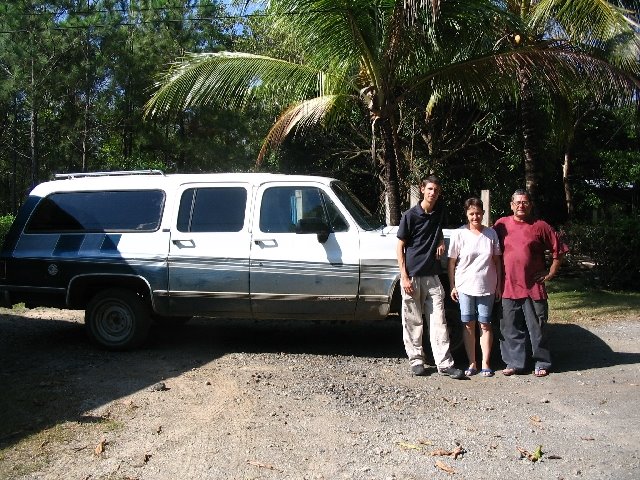 Former and new owners of the Suburban. May it consume many more gallons of gas. *sheds tear.
Saturday, April 22, 2006
lost car, found god
So, i sold the car, to these nice people!
I visited them in what the guidebook says is a campsite, but which is actually a sort of church retreat place. Of course i was not the first so misinformed, so they, used to such visitors, let me stay. More than that, they offered me a room instead of camping in the car, invited me to eat with them every day, and didn't charge me a cent for anything!
During dinner the first evening I told my story about the import tax, and Heinz showed an interest in buying the car. After 3 days of hilarious 5 hour waits and paperwork shuffling, the car is now his. We agreed that he would pay $1500 for the car, and i would get whatever remained after the tax was charged. I didn't think this would be much, but i didn't feel that i could ask for more than $1500 given the condition of the car, and more to the point its gas consumption. In the end, i ended up legally relieving myself of the car, and with $500 in fresh notes in my pocket. I don't think i got such a bad deal.
However, on the last night, i discovered why everything up to that point had been free: friendly dr erika jekyll turned into evangelical erika hyde! I was subjected to a 90 minute theology lesson which was rendered in such simplistic terms that although initially i felt i was being patronised, i begun to realise about 60 minutes in that in fact it was an insidious form of hypnotism. I was also taken to a church service under the vague impression that it was some kind of "meeting". It was the first time i had been to a church service in a decade, and worse of all all the songs were in spanish and i didnt even know the tunes! Still, it was pretty interesting.
Thankfully i made it out of there with my life and my wits intact, with only a gideon bible in spanish and english on facing pages to remember my ordeal by.
In fact, this strange experience came at a rather odd moment. One might even say that it had been sent by God - to warn me away from Christianity? After finishing reading The Brothers Karamazov, and Strait Is The Gate, both of which deal with the issue of Virtue, in the implied context of Christianity, I was starting to leave behind some of my Humanistic prejudices, and to think that there was something to this whole religion thing after all.
I have always been a little wary of writing off things which have been accepted for centuries as true even when they apparently are not. I had begun reflecting that although there is a difference between a literal truth (eg, Brighton Beach is pebbly) and a metaphorical truth (eg, Jesus Christ is the way, the truth, and the life, and no man cometh to the Father but by him), metaphorical truths are so crucially important in holding societies together, and in fact in allowing the limited human mind to grasp greater things, that to consider them "untrue" is more or less a mistake. I had decided to study religions a little more closely, starting, perhaps, by reading the Bible. When I thought about my beliefs, I thought that perhaps they coincided with those of a Christian closer than I had liked to think.
However, then, like cold water being thrown in my face, I received a reality update. During the ninety minute lesson from Erika, and the 30 minute sermon from German Evangelical Willi, all the doubts from my adolescence which had caused me to abandon Christianity in favour of a humanist based morality ("since we are all that there is, it is doubly important to be nice to each other") resurged.
I will still study the Bible. It is certainly edifying. A book that has lasted 2000 years begs careful examination. But, since I am very certain, after 28 years of reflection, that I will not confuse metaphorical with literal truth, I will never be a Christian, or indeed a Buddhist, or a Pagan, or a Rastafarian.
Religion scares me most and seems most absurd when it is not woven into the societal context in which it exists, and seems most sensible when it is so integrated. This seems to tell me something about the meaning of metaphorical truths. I think that perhaps my problem with a purely hedonistic society such as many seem to live in is that it seems to have /no/ metaphorical truths woven into it.
A diverting episode in the countryside, in which i did more than just sell a big car to an exceedingly friendly, helpful, kind and amiable man.
** I do not intend to insult anyone with this post, and I apologise if I have done so. I am still aware that there is the possibility of a bigger truth out there that I still perhaps just don't see, that others do. But all I can do is reflect what I honestly believe right now. **
*** This post is so inflammatory and so complex that I need at least 5 times the time I actually have to dedicate to it, but unfortunately I am paying by the minute so the raw article will have to do. ***
I visited them in what the guidebook says is a campsite, but which is actually a sort of church retreat place. Of course i was not the first so misinformed, so they, used to such visitors, let me stay. More than that, they offered me a room instead of camping in the car, invited me to eat with them every day, and didn't charge me a cent for anything!
During dinner the first evening I told my story about the import tax, and Heinz showed an interest in buying the car. After 3 days of hilarious 5 hour waits and paperwork shuffling, the car is now his. We agreed that he would pay $1500 for the car, and i would get whatever remained after the tax was charged. I didn't think this would be much, but i didn't feel that i could ask for more than $1500 given the condition of the car, and more to the point its gas consumption. In the end, i ended up legally relieving myself of the car, and with $500 in fresh notes in my pocket. I don't think i got such a bad deal.
However, on the last night, i discovered why everything up to that point had been free: friendly dr erika jekyll turned into evangelical erika hyde! I was subjected to a 90 minute theology lesson which was rendered in such simplistic terms that although initially i felt i was being patronised, i begun to realise about 60 minutes in that in fact it was an insidious form of hypnotism. I was also taken to a church service under the vague impression that it was some kind of "meeting". It was the first time i had been to a church service in a decade, and worse of all all the songs were in spanish and i didnt even know the tunes! Still, it was pretty interesting.
Thankfully i made it out of there with my life and my wits intact, with only a gideon bible in spanish and english on facing pages to remember my ordeal by.
In fact, this strange experience came at a rather odd moment. One might even say that it had been sent by God - to warn me away from Christianity? After finishing reading The Brothers Karamazov, and Strait Is The Gate, both of which deal with the issue of Virtue, in the implied context of Christianity, I was starting to leave behind some of my Humanistic prejudices, and to think that there was something to this whole religion thing after all.
I have always been a little wary of writing off things which have been accepted for centuries as true even when they apparently are not. I had begun reflecting that although there is a difference between a literal truth (eg, Brighton Beach is pebbly) and a metaphorical truth (eg, Jesus Christ is the way, the truth, and the life, and no man cometh to the Father but by him), metaphorical truths are so crucially important in holding societies together, and in fact in allowing the limited human mind to grasp greater things, that to consider them "untrue" is more or less a mistake. I had decided to study religions a little more closely, starting, perhaps, by reading the Bible. When I thought about my beliefs, I thought that perhaps they coincided with those of a Christian closer than I had liked to think.
However, then, like cold water being thrown in my face, I received a reality update. During the ninety minute lesson from Erika, and the 30 minute sermon from German Evangelical Willi, all the doubts from my adolescence which had caused me to abandon Christianity in favour of a humanist based morality ("since we are all that there is, it is doubly important to be nice to each other") resurged.
I will still study the Bible. It is certainly edifying. A book that has lasted 2000 years begs careful examination. But, since I am very certain, after 28 years of reflection, that I will not confuse metaphorical with literal truth, I will never be a Christian, or indeed a Buddhist, or a Pagan, or a Rastafarian.
Religion scares me most and seems most absurd when it is not woven into the societal context in which it exists, and seems most sensible when it is so integrated. This seems to tell me something about the meaning of metaphorical truths. I think that perhaps my problem with a purely hedonistic society such as many seem to live in is that it seems to have /no/ metaphorical truths woven into it.
A diverting episode in the countryside, in which i did more than just sell a big car to an exceedingly friendly, helpful, kind and amiable man.
** I do not intend to insult anyone with this post, and I apologise if I have done so. I am still aware that there is the possibility of a bigger truth out there that I still perhaps just don't see, that others do. But all I can do is reflect what I honestly believe right now. **
*** This post is so inflammatory and so complex that I need at least 5 times the time I actually have to dedicate to it, but unfortunately I am paying by the minute so the raw article will have to do. ***
Sunday, April 16, 2006
return
so... as beth hinted in her comment, she's thinking of getting married. cor blimey, another year, another friend married off.
i will, of course, be returning to sunny britain for this event!
so now i have a definite end-point to my wanderings. london (or thereabouts), and october. so i'll see you all then! however, i might not necessarily stay around, i have some new thoughts on that score... but let's see first if i have any money by then.
i crossed into panama at the hilarious sixaola crossing near the Caribbean coast, where there is only recently a road. the bridge across the river which defines the border is a single-track railway bridge. they have put railway sleepers alongside each rail to allow road traffic to precariously pass over. When you get to the other side, you just leave your car on the railway line, causing chaos for people coming the other way (no, there is no signalling in place!) whilst you wait for a bloke to type out a temporary importation permit. luckily, most people don't bring vehicles over this crossing!
however, you might find that the bloke asks you what your final destination is, and you might say, "er, here!", and he might say, that'll be $1000 please. because if you are importing a vehicle then you must have to pay the import duty, naturellement!
so then, you might change your mind, and remember that after all you were planning to take it with you in your suitcase when you flew -- ah, i mean, took the non-existent car ferry -- to colombia. and you might ask the bloke, hypothetically, what would happen if the car were to, say, fall in the sea? and you would be upset to find that even in this instance, you would still have to pay the panamanian government $1000 for the pleasure.
uh-oh.
but all is not (quite) lost: i have an address of another bloke in panama city who may have a different story, or offer me some kind of loophole. a bit of a laugh though, as i'm sure you'll agree!
i will, of course, be returning to sunny britain for this event!
so now i have a definite end-point to my wanderings. london (or thereabouts), and october. so i'll see you all then! however, i might not necessarily stay around, i have some new thoughts on that score... but let's see first if i have any money by then.
i crossed into panama at the hilarious sixaola crossing near the Caribbean coast, where there is only recently a road. the bridge across the river which defines the border is a single-track railway bridge. they have put railway sleepers alongside each rail to allow road traffic to precariously pass over. When you get to the other side, you just leave your car on the railway line, causing chaos for people coming the other way (no, there is no signalling in place!) whilst you wait for a bloke to type out a temporary importation permit. luckily, most people don't bring vehicles over this crossing!
however, you might find that the bloke asks you what your final destination is, and you might say, "er, here!", and he might say, that'll be $1000 please. because if you are importing a vehicle then you must have to pay the import duty, naturellement!
so then, you might change your mind, and remember that after all you were planning to take it with you in your suitcase when you flew -- ah, i mean, took the non-existent car ferry -- to colombia. and you might ask the bloke, hypothetically, what would happen if the car were to, say, fall in the sea? and you would be upset to find that even in this instance, you would still have to pay the panamanian government $1000 for the pleasure.
uh-oh.
but all is not (quite) lost: i have an address of another bloke in panama city who may have a different story, or offer me some kind of loophole. a bit of a laugh though, as i'm sure you'll agree!
snake!
oh yeah, and i remembered today about that snake we saw! except, well, actually i was the only one that saw it, incredibly.
we were driving along this long dirt track out of the deserted santa rosa national park, where we'd already seen a bunch of birds and things, when i saw this huge yellow snake at least the width of the car (and its a big car, as i might have mentioned), curled across the road. i jumped on the brakes. and i was all, "look, there's a huge snake!" and simone was all, "er what where?" and i was all, "that huge yellow thing the size of a person right in front of us!" and simone was all, "what?" and it sort of started, leisurelyly pulled all its coils up, and slithered off into the undergrowth.
i was glad we weren't hiking! and it was quite near houses and things. what larks eh pip, what larks!
we were driving along this long dirt track out of the deserted santa rosa national park, where we'd already seen a bunch of birds and things, when i saw this huge yellow snake at least the width of the car (and its a big car, as i might have mentioned), curled across the road. i jumped on the brakes. and i was all, "look, there's a huge snake!" and simone was all, "er what where?" and i was all, "that huge yellow thing the size of a person right in front of us!" and simone was all, "what?" and it sort of started, leisurelyly pulled all its coils up, and slithered off into the undergrowth.
i was glad we weren't hiking! and it was quite near houses and things. what larks eh pip, what larks!
Friday, April 07, 2006
wildlife!
well costa rica has been a nature trip. Memorably, we saw
coatis, squirrel monkeys, quetzales, bell birds, agoutis, jays, vultures, all kinds of hummingbirds, frigate birds, trogons, iguanas, and memorably a roadside hawk tearing apart its prey, at the roadside. All in the wild! We also saw any number of different birds and butterflies which we didn't manage to identify. Simone, you might want to post some more on here, if you can remember any! Simone also saw a two-tailed sloth and caimans and some more things, because she went on a guided tour whilst I saved my money.
The cloud forest is amazing to walk through, and the birds really don't seem shy of humans at all.
It's funny because wildlife has sort of been a background feature of my trip so far, if that, so it was great to live someone else's trip for a while. And, naturally, it turned out to be super-interesting and I'm really glad I got the opportunity to see it all! And we did our fair share of people-meeting too, what with park rangers, who are always informed and interesting, and our little adventure in cuajaniquil where i inadvertantly er ran out of gas on the way out of the valley, and we spent a good hour begging gallons of gas around town. It was really embarrassing and drove the point home hard about what an offensive beast the Suburban is, that we poured in a huge bucket full of gas, and it only got us the 15 miles to the next town, and gas station. I think I'll have to promise never to drive a car again, to make up for the damage I've done to the environment in the last 7 months...
coatis, squirrel monkeys, quetzales, bell birds, agoutis, jays, vultures, all kinds of hummingbirds, frigate birds, trogons, iguanas, and memorably a roadside hawk tearing apart its prey, at the roadside. All in the wild! We also saw any number of different birds and butterflies which we didn't manage to identify. Simone, you might want to post some more on here, if you can remember any! Simone also saw a two-tailed sloth and caimans and some more things, because she went on a guided tour whilst I saved my money.
The cloud forest is amazing to walk through, and the birds really don't seem shy of humans at all.
It's funny because wildlife has sort of been a background feature of my trip so far, if that, so it was great to live someone else's trip for a while. And, naturally, it turned out to be super-interesting and I'm really glad I got the opportunity to see it all! And we did our fair share of people-meeting too, what with park rangers, who are always informed and interesting, and our little adventure in cuajaniquil where i inadvertantly er ran out of gas on the way out of the valley, and we spent a good hour begging gallons of gas around town. It was really embarrassing and drove the point home hard about what an offensive beast the Suburban is, that we poured in a huge bucket full of gas, and it only got us the 15 miles to the next town, and gas station. I think I'll have to promise never to drive a car again, to make up for the damage I've done to the environment in the last 7 months...
Monday, April 03, 2006
Green city
Managua, Nicaragua's capital, was half-destroyed in 1973 by an earthquake, and efforts at rebuilding have been minimal. Climbing the small hill in the middle of the city for the views, one has the impression of looking out over a large forest, with the odd cluster of buildings poking up here and there. Descending into the old centre, there are huge deserted expanses of shabby-looking concrete and trees, with the odd original building left standing here and there. It is a very odd place.
I stayed in the Barrio where all the budget hotels are, which unfortunately is a relatively high-crime area. Most of Managua is, however. I was repeatedly warned never to go out with my passport or more money than I absolutely needed, and a trip to the cash machine meant taking a taxi ten blocks, taking shelter in the shopping mall (a completely incongruous slice of norteamericana), then taking a taxi right home again, where the hotel owner would unlock the door for me. One night I went one block down to get some gallo pinto for dinner at a small local eatery, and saw an old man wandering the streets with a machete. "Old Miguelito," they told me back at the hotel. "Yes, he patrols the streets to keep this block safer for our guests." We heard his whistle throughout the evenings. I wondered what he would do if set upon by a gang of street kids.
Despite all that, I quite liked the few days I spent in Managua, because it at least felt authentic, and had a few museums, a theatre, two cinemas, and other trappings of a proper city. Still, when I left and finally could relax a little from the perpetual fear of crime, I did breathe a sigh of relief.
I also visited Granada and Leon, the two colonial towns and backpacker-hangouts of Nicaragua. I met lots of interesting international people, read the Brothers Karamazov in a hammock, ate great spaghetti bolognese, and sometimes braved the heat to take in the unquestionably beautiful architecture.
My favorite spot though was Isla de Ometepe, which I made the trek to even though I only had one day before I needed to be in Costa Rica. I braved the 90 minute ferry ride each way, which was the choppiest I've ever had (crazy considering it's a lake, not even the sea) and a one-hour bus ride to spend just one night at sleepy Altagracia. But the people of the island lived up to their reputation as the friendliest in Nicaragua, and I received so many genuine smiles it was worth the trip. Thanks especially to Juan who after chatting to me on the bus and finding I was going to his home town, offered to lend me his bike to explore the town. On my return, he and his friends cooked up a delicious sopa de pollo and invited me to share it with them. I also got to sample an extremely potent drink made by pouring a litre of beer and a half-bottle of rum into a small cooler full of ice, which was then passed round the table. I only wish I'd had longer to spend on the island. I will certainly return if I ever get the opportunity.
Thence to Costa Rica, and an amazing array of bird and plant life: I am excited to say that I saw not one but three resplendent quetzales, and a mating pair of three-wattled bellbirds! But that is another blog entry.
I stayed in the Barrio where all the budget hotels are, which unfortunately is a relatively high-crime area. Most of Managua is, however. I was repeatedly warned never to go out with my passport or more money than I absolutely needed, and a trip to the cash machine meant taking a taxi ten blocks, taking shelter in the shopping mall (a completely incongruous slice of norteamericana), then taking a taxi right home again, where the hotel owner would unlock the door for me. One night I went one block down to get some gallo pinto for dinner at a small local eatery, and saw an old man wandering the streets with a machete. "Old Miguelito," they told me back at the hotel. "Yes, he patrols the streets to keep this block safer for our guests." We heard his whistle throughout the evenings. I wondered what he would do if set upon by a gang of street kids.
Despite all that, I quite liked the few days I spent in Managua, because it at least felt authentic, and had a few museums, a theatre, two cinemas, and other trappings of a proper city. Still, when I left and finally could relax a little from the perpetual fear of crime, I did breathe a sigh of relief.
I also visited Granada and Leon, the two colonial towns and backpacker-hangouts of Nicaragua. I met lots of interesting international people, read the Brothers Karamazov in a hammock, ate great spaghetti bolognese, and sometimes braved the heat to take in the unquestionably beautiful architecture.
My favorite spot though was Isla de Ometepe, which I made the trek to even though I only had one day before I needed to be in Costa Rica. I braved the 90 minute ferry ride each way, which was the choppiest I've ever had (crazy considering it's a lake, not even the sea) and a one-hour bus ride to spend just one night at sleepy Altagracia. But the people of the island lived up to their reputation as the friendliest in Nicaragua, and I received so many genuine smiles it was worth the trip. Thanks especially to Juan who after chatting to me on the bus and finding I was going to his home town, offered to lend me his bike to explore the town. On my return, he and his friends cooked up a delicious sopa de pollo and invited me to share it with them. I also got to sample an extremely potent drink made by pouring a litre of beer and a half-bottle of rum into a small cooler full of ice, which was then passed round the table. I only wish I'd had longer to spend on the island. I will certainly return if I ever get the opportunity.
Thence to Costa Rica, and an amazing array of bird and plant life: I am excited to say that I saw not one but three resplendent quetzales, and a mating pair of three-wattled bellbirds! But that is another blog entry.
Tuesday, March 14, 2006
Honduras
The crossing into Honduras was a nightmare. Everything that I had feared up until then, but had happily not happened, all came on one day, just when I was thinking I'd got the whole border thing sewn up.
It cost me nearly US$70 to finally get into Honduras with the car, including having to bribe the police twice due to an alleged missing fire extinguisher. Hmmm. It's scary being pulled over on a mountain road by a military-uniformed surly-looking man with gold teeth and a machine gun. Yes, the fine would be 2,000 lempiras. Or I could pay him $20 right here, he implied. Unfortunately for me, I didn't have even $20, after my thorough rinsing at the border (apparently, a permit to bring a car through Honduras for a few days costs US$25. Ah, plus a number of "administration fees".) I showed the nice man the five one-dollar bills I did have left, sweating profusely. Miraculously, unpredictably, he accepted them and wished me a safe trip.
There are a bunch of criminals at every border, tramitadores they like to be called, and you pay them a few dollars to help you through the process. You might expect to even be helped. But mostly, they just make sure that the relevant palms get greased. To be fair, the entry into Honduras was the most complex thing I've ever seen, taking several hours between innumerable offices, each box-like room with a couple of shifty-looking individuals playing solitaire on 386s, who would take 2 photocopies of form X4c and print and stamp form Zn9 and give you form PP1 to sign and ask for $5. So the guy probably did help me somewhat. But it's not like you have any choice anyway: the only way to get the shouting mass of dishevelled gold-toothed louts to desist is to accept the "help" of one of them.
Today, four days later, I had finally managed to screw up the courage to attempt to cross into Nicaragua. I had prepared plenty of cash, in various currencies and denominations, spread around my person. After the Honduran police robbed me again ($10 this time) a mile or so before the border, I was ready to face hell to get into Nicaragua. And then... it was a breeze. There was hardly anyone there, everyone was polite and quick, and no-one charged me anything, except for the official $7 entry fee. Nothing at all for the car.
It's all very strange. One would almost think that the alternating horrendous and straightforward crossings had been set up by a master of psychological torture.
So apart from the border crossings... Choluteca was horribly hot, and I should have even paid for air conditioning. I spent a lot of time lying under the ceiling fan in my pants in the hotel room going "urgh", not sleeping well, and having many cold showers a day. I did however meet some lovely and interesting people the few times I did go out and brave the baking gringoless streets. Some people were a little surly but I spent a great evening drinking with the owner of a restaurant and his friends and family, and another morning talking with the sister of the owner of the comedor I ate breakfast at while she was waiting for college. Had almost forgotten what white people look like until I got to Estelí today: I think I am back on the tourist trail.
It cost me nearly US$70 to finally get into Honduras with the car, including having to bribe the police twice due to an alleged missing fire extinguisher. Hmmm. It's scary being pulled over on a mountain road by a military-uniformed surly-looking man with gold teeth and a machine gun. Yes, the fine would be 2,000 lempiras. Or I could pay him $20 right here, he implied. Unfortunately for me, I didn't have even $20, after my thorough rinsing at the border (apparently, a permit to bring a car through Honduras for a few days costs US$25. Ah, plus a number of "administration fees".) I showed the nice man the five one-dollar bills I did have left, sweating profusely. Miraculously, unpredictably, he accepted them and wished me a safe trip.
There are a bunch of criminals at every border, tramitadores they like to be called, and you pay them a few dollars to help you through the process. You might expect to even be helped. But mostly, they just make sure that the relevant palms get greased. To be fair, the entry into Honduras was the most complex thing I've ever seen, taking several hours between innumerable offices, each box-like room with a couple of shifty-looking individuals playing solitaire on 386s, who would take 2 photocopies of form X4c and print and stamp form Zn9 and give you form PP1 to sign and ask for $5. So the guy probably did help me somewhat. But it's not like you have any choice anyway: the only way to get the shouting mass of dishevelled gold-toothed louts to desist is to accept the "help" of one of them.
Today, four days later, I had finally managed to screw up the courage to attempt to cross into Nicaragua. I had prepared plenty of cash, in various currencies and denominations, spread around my person. After the Honduran police robbed me again ($10 this time) a mile or so before the border, I was ready to face hell to get into Nicaragua. And then... it was a breeze. There was hardly anyone there, everyone was polite and quick, and no-one charged me anything, except for the official $7 entry fee. Nothing at all for the car.
It's all very strange. One would almost think that the alternating horrendous and straightforward crossings had been set up by a master of psychological torture.
So apart from the border crossings... Choluteca was horribly hot, and I should have even paid for air conditioning. I spent a lot of time lying under the ceiling fan in my pants in the hotel room going "urgh", not sleeping well, and having many cold showers a day. I did however meet some lovely and interesting people the few times I did go out and brave the baking gringoless streets. Some people were a little surly but I spent a great evening drinking with the owner of a restaurant and his friends and family, and another morning talking with the sister of the owner of the comedor I ate breakfast at while she was waiting for college. Had almost forgotten what white people look like until I got to Estelí today: I think I am back on the tourist trail.
Monday, March 13, 2006
Some extremely out of date pictures
 "Warning, mountains in rear view mirror are closer than they appear" -- crossing the Rockies, Colorado.
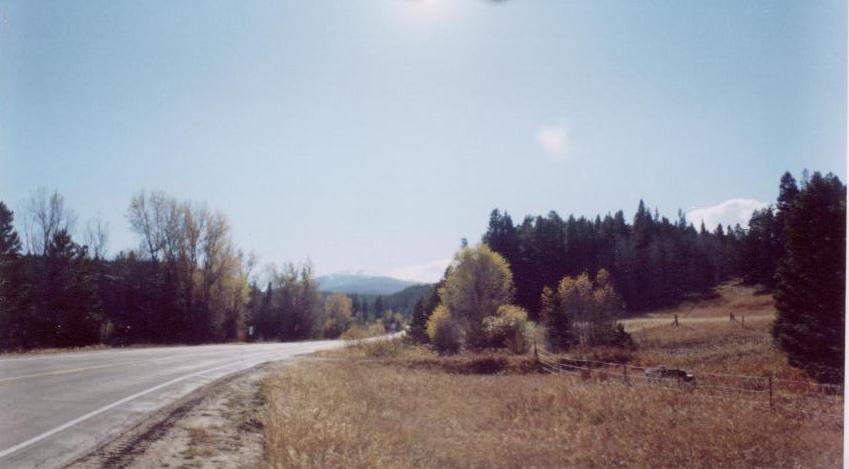 A beautiful clear day near Boulder.
 The Burban in the Sierras, California.
 Perched on a rock above the Grand Canyon watching the sunset.
 Caroline the beautiful Quebecoise poses in the Burban in Zacatecas, Mexico.
Tuesday, March 07, 2006
Revolutionary zeal
At the Guatemalan-Salvadorean border I avoided paying the US$80 "exit fee" that a shifty looking man in sportswear tried to levy. They were rank amateurs though: starting with an amount that just made me stare, then laugh, then immediately halving the alleged tax. No, I thought, I'll just chance my luck without this vitally important signature.
Mayan-Guatemalan women are slim, dressed in loose-fitting traditional skirts and blouses, have long clean hair and wear no makeup. They are beautiful. Salvadorean women are fat, wear tight cheap fashions that make them look fatter, put makeup on with a trowel, and apparently comb their hair with goose fat every morning. They are not beautiful. The men look at you suspiciously. Certainly this is a country less used to outsiders. However, when I have actually stopped to talk to people, I have found everyone to be more than welcoming, and helpful and friendly. Eating breakfast pupusas in Sonsonate, the owner came down with a big grin and invited me to stay in his house! Lots of people here speak some English, as a huge proportion of people are or have worked in the US.
San Salvador is odd. The affluent and leafy Western suburbs (where my hostel is situated) seem like a North American city, in lots of ways. There are three malls, and many gas stations and US fast-food establishments. Then, you can take a bus or a 30 minute walk to the centre, which resembles nothing so much as a huge 30-block street market, with a Cathedral and Plaza more or less buried in the middle, and pretty much not a lot else. I went looking for the Science Museum but didn't have the exact address, and two sets of other Museum curators plus the Sheraton staff couldn't tell me where it was. In fact they thought it didn't exist. It was about two blocks away.
So apart from the capital, I've been hiking in Bosque El Impossible (swimming in the river yay!), and hung out for a day on Lago Coatepeque. I managed to be present for the FMLN's political rallies in both Suchitoto and San Salvador -- quite an experience! They are the party that formed out of the guerillas of the Civil War, and the revolutionary spirit is still very much alive. It was quite fun standing in a city Plaza packed with people wearing red chanting "Hasta La Victoria Siempre!"
Now east, through Eastern El Salvador, then skipping through a very small and by all accounts unremarkable corner of Honduras to Nicaragua. It's hot here!
Mayan-Guatemalan women are slim, dressed in loose-fitting traditional skirts and blouses, have long clean hair and wear no makeup. They are beautiful. Salvadorean women are fat, wear tight cheap fashions that make them look fatter, put makeup on with a trowel, and apparently comb their hair with goose fat every morning. They are not beautiful. The men look at you suspiciously. Certainly this is a country less used to outsiders. However, when I have actually stopped to talk to people, I have found everyone to be more than welcoming, and helpful and friendly. Eating breakfast pupusas in Sonsonate, the owner came down with a big grin and invited me to stay in his house! Lots of people here speak some English, as a huge proportion of people are or have worked in the US.
San Salvador is odd. The affluent and leafy Western suburbs (where my hostel is situated) seem like a North American city, in lots of ways. There are three malls, and many gas stations and US fast-food establishments. Then, you can take a bus or a 30 minute walk to the centre, which resembles nothing so much as a huge 30-block street market, with a Cathedral and Plaza more or less buried in the middle, and pretty much not a lot else. I went looking for the Science Museum but didn't have the exact address, and two sets of other Museum curators plus the Sheraton staff couldn't tell me where it was. In fact they thought it didn't exist. It was about two blocks away.
So apart from the capital, I've been hiking in Bosque El Impossible (swimming in the river yay!), and hung out for a day on Lago Coatepeque. I managed to be present for the FMLN's political rallies in both Suchitoto and San Salvador -- quite an experience! They are the party that formed out of the guerillas of the Civil War, and the revolutionary spirit is still very much alive. It was quite fun standing in a city Plaza packed with people wearing red chanting "Hasta La Victoria Siempre!"
Now east, through Eastern El Salvador, then skipping through a very small and by all accounts unremarkable corner of Honduras to Nicaragua. It's hot here!
Monday, February 27, 2006
avoiding bandits, meeting friends
On the road down into San Pedro La Laguna, Lago Atitlán, I encountered a broken down chicken bus blocking the carriageway. A man optimistically waved me through, so I pulled forward, only to find that the gap was pretty much not Suburban-sized. Trying to reverse back up the hairpin, I only slid further forward, and when the bus to my right itself slipped off the rocks holding it, 6 inches toward me, I just gave up and breathing in, slithered the ´Burban through the gap. I am starting to get pretty proud of my ability to navigate the beast. Which probably means I am due a crash. Actually, I did have a pranglet in Santa Cruz, as I left, in the parking lot. I had to do some crazy N-point turns to get out the gate, and the rear windows were all muddy. I tried to do it on intuition but misjudged the length of the car by about 2 inches. I made a two-inch dent in a Toyota truck's bull bars. Needless to say the Suburban was unscathed, yet again. Unfortunately the owner was standing right there: fortunately, they were two super-nice guys from Guatemala city, and although they started off a bit upset (reasonably enough!) when I was contrite, they were very friendly. I ended up giving them 100 quetzales to get the bar knocked back into place. Actually I have the best conversations with people through car-related events (just to counter those people who thought that by travelling by car I wouldn't meet people!).
Since there was two chicken-buses-worth of passengers milling about in the road, a good hour's walk in the sun to the nearest town, I offered lifts to one group, 8 schoolteachers from San Pedro. They were very helpful with directions, and interesting to chat to. Although I generally feel guilty driving such a huge car, I do really enjoy all the conversations with the people I give rides to.
Lago Atitlán is pretty. I had never really thought before how much volcanoes add to the beauty of a place. I think because they are a bit like the mountains in children's books -- conical, wooded, with tops shrouded in clouds. The place I stayed was odd. It resembled nothing so much as the greenfields area in Glastonbury. Lots of nice places to hang out run by hippies, with reggae music, fruit smoothies, good organic coffee and fresh bread, all that sort of thing. After spending a few hours one afternoon chilling out in one place, reading a book on Central America, I came out onto the footpath and was actually surprised to see Guatemalans there. Still, the local people seem to generally like the hippies. There are lots of friendly women and kids selling cakes and ice-creams and handcrafts, and they are super good-natured, even when you never buy anything. I have found that from the Maya: when you politely, with a smile, decline whatever they are offering, they smile back and move on. Intimidation seems not to be a part of their culture. It makes for a pleasant atmosphere.
I think every one of the four days that I spent in San Pedro, I met at least one person who I knew from previous encounters on the gringo trail. It's surreal. It's so nice to see people you thought maybe you'd never see again, and find out what they've been up to. So there was no shortage of friends to hang out with, and rooms were just a few dollars a night. I can understand why people stay there a while! However, I still began to feel after a few days that it was time to move on. I heard so many warnings about bandits on various roads around San Pedro that I was almost disappointed when I got all the back to the Carretera Interamericana without meeting a single one. Perhaps they don't work Sundays.
Antigua is really one of the most beautiful cities I have ever seen. Every corner seems is a photograph waiting to be taken. Bright sunshine and clear blue skies frame time-faded or brightly-painted colonial houses, and lilac and bougainvillea trees fill the courtyards of crumbling ruins of convents, churches and monasteries. The colourful Maya handcraft and produce markets crowd the cobbled streets. And always the green slopes of one of the three volcanoes surrounding the city visible beyond. It is very touristy, with a lot of rich Guatemalans and El Salvadorean tourists as well as gringos, but really they don't spoil the picturesqueness. It is so expensive I am only staying one day, but it is definitely somewhere I would love to return to, with money. It is slightly less good for a solo traveller than other places, because it isn't really possibly to "lose yourself" in the city.
But I have bought a map of El Salvador, and will cross the border tomorrow. It has been a very rapid two-week tour of Guatemala, but I have done pretty well at seeing a diverse range of places. I don't even know what to expect of El Salvador, which is quite exciting in a way!
Since there was two chicken-buses-worth of passengers milling about in the road, a good hour's walk in the sun to the nearest town, I offered lifts to one group, 8 schoolteachers from San Pedro. They were very helpful with directions, and interesting to chat to. Although I generally feel guilty driving such a huge car, I do really enjoy all the conversations with the people I give rides to.
Lago Atitlán is pretty. I had never really thought before how much volcanoes add to the beauty of a place. I think because they are a bit like the mountains in children's books -- conical, wooded, with tops shrouded in clouds. The place I stayed was odd. It resembled nothing so much as the greenfields area in Glastonbury. Lots of nice places to hang out run by hippies, with reggae music, fruit smoothies, good organic coffee and fresh bread, all that sort of thing. After spending a few hours one afternoon chilling out in one place, reading a book on Central America, I came out onto the footpath and was actually surprised to see Guatemalans there. Still, the local people seem to generally like the hippies. There are lots of friendly women and kids selling cakes and ice-creams and handcrafts, and they are super good-natured, even when you never buy anything. I have found that from the Maya: when you politely, with a smile, decline whatever they are offering, they smile back and move on. Intimidation seems not to be a part of their culture. It makes for a pleasant atmosphere.
I think every one of the four days that I spent in San Pedro, I met at least one person who I knew from previous encounters on the gringo trail. It's surreal. It's so nice to see people you thought maybe you'd never see again, and find out what they've been up to. So there was no shortage of friends to hang out with, and rooms were just a few dollars a night. I can understand why people stay there a while! However, I still began to feel after a few days that it was time to move on. I heard so many warnings about bandits on various roads around San Pedro that I was almost disappointed when I got all the back to the Carretera Interamericana without meeting a single one. Perhaps they don't work Sundays.
Antigua is really one of the most beautiful cities I have ever seen. Every corner seems is a photograph waiting to be taken. Bright sunshine and clear blue skies frame time-faded or brightly-painted colonial houses, and lilac and bougainvillea trees fill the courtyards of crumbling ruins of convents, churches and monasteries. The colourful Maya handcraft and produce markets crowd the cobbled streets. And always the green slopes of one of the three volcanoes surrounding the city visible beyond. It is very touristy, with a lot of rich Guatemalans and El Salvadorean tourists as well as gringos, but really they don't spoil the picturesqueness. It is so expensive I am only staying one day, but it is definitely somewhere I would love to return to, with money. It is slightly less good for a solo traveller than other places, because it isn't really possibly to "lose yourself" in the city.
But I have bought a map of El Salvador, and will cross the border tomorrow. It has been a very rapid two-week tour of Guatemala, but I have done pretty well at seeing a diverse range of places. I don't even know what to expect of El Salvador, which is quite exciting in a way!
Tuesday, February 21, 2006
Four punctures in two days
So... sometime around Valentine's day I left Belize and braved the corruption and anarchy of Guatemala. I should immediately say that I have seen no sign of anything like this. The border was very straightforward, and the helpful man who took me through all the steps was interesting, friendly, and didn't even ask me for any money. I offered him 10 quetzales to thank him, about 70p, and he seemed cheerful enough!
Northern Guatemala is somewhat like Belize -- sparsely populated, forested, and with villages strung along the road in which everyone will smile and return waves and greetings as you pass through. I find it so soul-nourishing to have these little encounters with people. I was talking last night to the Finn who I have been travelling with for the last four days, since Tikal, about friendships. It seems that, unable to deal with the temporary nature of life (we all die), we like to separate our relationships into the "temporary" and the "permanent". It can easily seem that only the permanent relationships have value, or meaning. But once you accept that in fact all your relationships are temporary, just shorter or longer, it is a great liberation and you realise that therefore all relationships have value. I have enjoyed travelling with Tuomas for four days, and the fact that we may never see each other again does not reduce that. Equally, I have valued exchanging genuinely happy greetings with men doing road repairs, women carrying packages on their heads, and children drawing water at wells, beside the road.
Tikal was pretty groovy. It is really a big rainforest, with huge enormous trees with monkeys, birds, and other wildlife in them, which incidentally contains a few giant stone pyramids! It is lovely to walk around, and I spent nearly a day there. Then, along with a Canadian couple and Tuomas I drove down to Lago Atitlan, taking four days and stopping often along the way. Apart from managing to get four punctures, and leaving my sandals and my towel in various hotels, it has been a fun trip. Actually things going wrong with the car has proved a great opportunity for meeting people. The guys who fixed my puncture in Fray Bartolome one evening for 15 quetzales (1 gbp) were super-friendly, and were so amused when I returned the next morning with another tyre that they fixed it for free! By the fourth wheel-change, I was getting pretty quick, at least.
So there we are. One night, we decided to stay in this hostel. It was so weird being suddenly transported back into gringolandia, with fruit smoothies and organic dinner, bonobo on the stereo, etc etc. Basically I found it pretty unpleasant, even though the riverside setting was beautiful, the people interesting and international and open to talking to strangers, and the prices good. I would have loved it in England, for sure. I suppose I've become so used to (so addicted to) extreme cultural dislocation that just sitting in a bar boozing with some Europeans somehow lacked lustre. I couldn't face going straight to Lago Atitlan, the next stop on the gringo trail, so I have stopped in Santa Cruz del Quiche for two days. There is absolutely nothing to do here, and I am pretty much the only gringo. The others have gone on to their various destinations. I will go to Atitlan though, and Antigua. I have to overcome my stupid cultural prejudice against First Worlders (or whatever you call us), since they are likely to be some of the most interesting First Worlders I'll ever meet. And I can at least hang out with them as equals.
So, probably another week in Guatemala, and then on into El Salvador, which I'm really looking forward to -- it has no traveller trail to speak of. Tuomas is generally of a like mind to me, so wants to go to El Savador too, so I hope we can join up again further down the road.
This morning I came across my 90 Doxycycline tablets, supposedly for three months travel in malarial parts of South America. The idea of continuing this rate of experience-exposure for another 7 months and 15 countries sometimes makes my mind feel like exploding. And makes me go hide in an Internet cafe ;). Presumably that's why most travellers stop from time to time for a few weeks in nice, safe, culturally easy gringo hangouts. But now that I've had the full on 100% cultural immersion experience, I find it hard to accept it diluted, even though keeping taking it neat might make my head explode!
Travel really is a drug.
Northern Guatemala is somewhat like Belize -- sparsely populated, forested, and with villages strung along the road in which everyone will smile and return waves and greetings as you pass through. I find it so soul-nourishing to have these little encounters with people. I was talking last night to the Finn who I have been travelling with for the last four days, since Tikal, about friendships. It seems that, unable to deal with the temporary nature of life (we all die), we like to separate our relationships into the "temporary" and the "permanent". It can easily seem that only the permanent relationships have value, or meaning. But once you accept that in fact all your relationships are temporary, just shorter or longer, it is a great liberation and you realise that therefore all relationships have value. I have enjoyed travelling with Tuomas for four days, and the fact that we may never see each other again does not reduce that. Equally, I have valued exchanging genuinely happy greetings with men doing road repairs, women carrying packages on their heads, and children drawing water at wells, beside the road.
Tikal was pretty groovy. It is really a big rainforest, with huge enormous trees with monkeys, birds, and other wildlife in them, which incidentally contains a few giant stone pyramids! It is lovely to walk around, and I spent nearly a day there. Then, along with a Canadian couple and Tuomas I drove down to Lago Atitlan, taking four days and stopping often along the way. Apart from managing to get four punctures, and leaving my sandals and my towel in various hotels, it has been a fun trip. Actually things going wrong with the car has proved a great opportunity for meeting people. The guys who fixed my puncture in Fray Bartolome one evening for 15 quetzales (1 gbp) were super-friendly, and were so amused when I returned the next morning with another tyre that they fixed it for free! By the fourth wheel-change, I was getting pretty quick, at least.
So there we are. One night, we decided to stay in this hostel. It was so weird being suddenly transported back into gringolandia, with fruit smoothies and organic dinner, bonobo on the stereo, etc etc. Basically I found it pretty unpleasant, even though the riverside setting was beautiful, the people interesting and international and open to talking to strangers, and the prices good. I would have loved it in England, for sure. I suppose I've become so used to (so addicted to) extreme cultural dislocation that just sitting in a bar boozing with some Europeans somehow lacked lustre. I couldn't face going straight to Lago Atitlan, the next stop on the gringo trail, so I have stopped in Santa Cruz del Quiche for two days. There is absolutely nothing to do here, and I am pretty much the only gringo. The others have gone on to their various destinations. I will go to Atitlan though, and Antigua. I have to overcome my stupid cultural prejudice against First Worlders (or whatever you call us), since they are likely to be some of the most interesting First Worlders I'll ever meet. And I can at least hang out with them as equals.
So, probably another week in Guatemala, and then on into El Salvador, which I'm really looking forward to -- it has no traveller trail to speak of. Tuomas is generally of a like mind to me, so wants to go to El Savador too, so I hope we can join up again further down the road.
This morning I came across my 90 Doxycycline tablets, supposedly for three months travel in malarial parts of South America. The idea of continuing this rate of experience-exposure for another 7 months and 15 countries sometimes makes my mind feel like exploding. And makes me go hide in an Internet cafe ;). Presumably that's why most travellers stop from time to time for a few weeks in nice, safe, culturally easy gringo hangouts. But now that I've had the full on 100% cultural immersion experience, I find it hard to accept it diluted, even though keeping taking it neat might make my head explode!
Travel really is a drug.
Monday, February 13, 2006
A week in Toledo
I have just spent four days in two Maya villages, Blue Creek and San Jose, in Toledo district in Southern Belize. One of the poorest regions in the country, it is incidentally where Maya Gold chocolate comes from. I stayed two days in a guesthouse, and two days with a family. I didn't take any pictures, due to my usual reticence in treating humans as photo opportunities. Here though are a few of my crowded impressions from those impression-filled few days.
Sharing the joy in accomplishment of reading with Juni, 8. Doing English by pointing at pictures with the smallest daughter. Eating hot bowls of chicken or pork caldo with fingers, accompanied by huge calabash-pots of corn tortillas, freshly cut, milled, patted and fried.
Many first-time experiences. Seeing glow-worms glimmering in the grass, like a trip. Riding with seven guys in the back of a pickup going to the village meeting. Sleeping (just) in a hammock. Washing in a stream surrounded by rainforest. Watching the mother wring a chicken's neck, helping to pull out its feathers, then only four hours later eating it.
Listening with growing incredulity as the village school principal talks enthusiastically, in complete seriousness, about the discovery of the lost city of Atlantis in 2004. "Somwair neeah Japan I tink." They are Maya, but they learn the Caribbean-inflected English used throughout Belize. It fits them, somehow.
Being interrupted mid-shave one morning by two giggling, wriggling sisters, hiding smiling behind shocks of jet-black hair, holding onto each other for support, feet bare, toes splayed, as they inform me: "Yur brekfass reddy!"
Finding myself naturally helping the women (sweeping the floor, plucking the chickens, playing with the children), unable to sit idly by while they work. Yet shying from offering my services with the men's work (raising a roof), embarrassed by my soft hands, weak arms, unsuitable for the task.
The 14-year-old neighbour sitting on the porch with me, telling me about the Romans, and his plans to study history. But when bidden inside by Valentino, he says his goodbyes; he won't come inside the other man's house.
No electricity: at night, the only light is from candles. And in San Jose, old mustard jars filled with kerosene, a length of wick piercing the lid. Sophia knocks one over in her excitement to show me the Maya Atlas. I, worried grownuply about fire hazard, recruit Valentino to help clear up, forgetting that he has been drinking. He snarls at the children and they scatter. He violently mops the tabletop with a nearby pair of trousers, spilling the vase of plastic flowers. Sophia appears, too late, meek and crestfallen, with the Toilet Peepah.
The children wonder at my truck. "It beautiful!" says Juni, simply. I demur: I well remember what a wreck it has looked in parking lots along the way. Yet here, 15 miles of dirt track between us and the rest of world, yes, it somehow does seem quite luxurious. Embarrasingly so.
Eggs and oranges undescribably delicious, eggy and orangey beyond where I had calibrated Eggness and Orangeness to be. Yet their chicken, free-range, organic, freshly killed, is surprisingly tough, gristly and dry.
Mostly, I am inspired and glow from the primal joyousness, the wholehearted dedication to living, the cheerfullness of the children (Valentino has 10, 2 boys and 8 girls. He tells me matter-of-factly that two have died: one in infancy, one at 19, of Hepatitis.) According to the Atlas, in most Maya villages children account for 60% of the population. Into adulthood, harder truths are apparent. The subordinate nature of the women's role. The alcoholism amongst the men, and the status games, the playing at being important, speechifying, self-congratulation.
But what has worked for centuries ought, perhaps, to be left to work now. They are paving the road to the villages, they say. Things will, of course, change. But the Maya people have been around since before the Romans: somehow I don't doubt that they will survive whatever comes their way.
Sharing the joy in accomplishment of reading with Juni, 8. Doing English by pointing at pictures with the smallest daughter. Eating hot bowls of chicken or pork caldo with fingers, accompanied by huge calabash-pots of corn tortillas, freshly cut, milled, patted and fried.
Many first-time experiences. Seeing glow-worms glimmering in the grass, like a trip. Riding with seven guys in the back of a pickup going to the village meeting. Sleeping (just) in a hammock. Washing in a stream surrounded by rainforest. Watching the mother wring a chicken's neck, helping to pull out its feathers, then only four hours later eating it.
Listening with growing incredulity as the village school principal talks enthusiastically, in complete seriousness, about the discovery of the lost city of Atlantis in 2004. "Somwair neeah Japan I tink." They are Maya, but they learn the Caribbean-inflected English used throughout Belize. It fits them, somehow.
Being interrupted mid-shave one morning by two giggling, wriggling sisters, hiding smiling behind shocks of jet-black hair, holding onto each other for support, feet bare, toes splayed, as they inform me: "Yur brekfass reddy!"
Finding myself naturally helping the women (sweeping the floor, plucking the chickens, playing with the children), unable to sit idly by while they work. Yet shying from offering my services with the men's work (raising a roof), embarrassed by my soft hands, weak arms, unsuitable for the task.
The 14-year-old neighbour sitting on the porch with me, telling me about the Romans, and his plans to study history. But when bidden inside by Valentino, he says his goodbyes; he won't come inside the other man's house.
No electricity: at night, the only light is from candles. And in San Jose, old mustard jars filled with kerosene, a length of wick piercing the lid. Sophia knocks one over in her excitement to show me the Maya Atlas. I, worried grownuply about fire hazard, recruit Valentino to help clear up, forgetting that he has been drinking. He snarls at the children and they scatter. He violently mops the tabletop with a nearby pair of trousers, spilling the vase of plastic flowers. Sophia appears, too late, meek and crestfallen, with the Toilet Peepah.
The children wonder at my truck. "It beautiful!" says Juni, simply. I demur: I well remember what a wreck it has looked in parking lots along the way. Yet here, 15 miles of dirt track between us and the rest of world, yes, it somehow does seem quite luxurious. Embarrasingly so.
Eggs and oranges undescribably delicious, eggy and orangey beyond where I had calibrated Eggness and Orangeness to be. Yet their chicken, free-range, organic, freshly killed, is surprisingly tough, gristly and dry.
Mostly, I am inspired and glow from the primal joyousness, the wholehearted dedication to living, the cheerfullness of the children (Valentino has 10, 2 boys and 8 girls. He tells me matter-of-factly that two have died: one in infancy, one at 19, of Hepatitis.) According to the Atlas, in most Maya villages children account for 60% of the population. Into adulthood, harder truths are apparent. The subordinate nature of the women's role. The alcoholism amongst the men, and the status games, the playing at being important, speechifying, self-congratulation.
But what has worked for centuries ought, perhaps, to be left to work now. They are paving the road to the villages, they say. Things will, of course, change. But the Maya people have been around since before the Romans: somehow I don't doubt that they will survive whatever comes their way.
Sunday, February 05, 2006
things
my 43things
although in fact, only 37 things (so far). how lacking in imagination i must be. or possibly just short of internet time.
what are yours?
although in fact, only 37 things (so far). how lacking in imagination i must be. or possibly just short of internet time.
what are yours?
Friday, February 03, 2006
frontiers
frontiers are wierd. discontinuities in the desert. i can't get my head round them. why is it that from tijuana to tulum, every cafe in mexico has a paper-napkin holder made of a vertical U of metal, but 3 miles south, across the belize border, suddenly everyone has decided that the correct object to hold paper napkins is a wooden tray with a sprung metal loop?
why is it that from vancouver to halifax, donuts are provided as a de rigeur snack on every street corner by tim horton; yet in america (an equally if not more snack-obsessed country) no such chain was to be seen?
why from baja california to patagonia do they speak spanish, yet in belize it is considered normal to speak english, instead? why do belizeans write their street names in paint on bits of wood, while mexicans get theirs sponsored by car manufacturers and printed on metal? why do mexicans drive like their pregnant wife is in the passenger seat, and belizeans like tomorrow would be soon enough?
the fact that differences in culture exist, i can understand (although even that question does bear reflection). what i find hard to understand is that one culture spans a large area of land, running right up to what is after all an imaginary line, and then suddenly, for no reason at all, just stops.
why is it that from vancouver to halifax, donuts are provided as a de rigeur snack on every street corner by tim horton; yet in america (an equally if not more snack-obsessed country) no such chain was to be seen?
why from baja california to patagonia do they speak spanish, yet in belize it is considered normal to speak english, instead? why do belizeans write their street names in paint on bits of wood, while mexicans get theirs sponsored by car manufacturers and printed on metal? why do mexicans drive like their pregnant wife is in the passenger seat, and belizeans like tomorrow would be soon enough?
the fact that differences in culture exist, i can understand (although even that question does bear reflection). what i find hard to understand is that one culture spans a large area of land, running right up to what is after all an imaginary line, and then suddenly, for no reason at all, just stops.
Thursday, February 02, 2006
beautiful belize
well the border crossing from mexico was superbly easy. they speak english here again! to begin with i kept addressing all officials in spanish, before i remembered. in the north there's lots of hispanic-looking people, some of whom actually don't speak english, so it's highly confusing.
it feels like a very civilised country, unlike mexico. everybody drives nice and slow, and coruzal, the first town on the road through belize, is so laid back its amazing. there's hardly any cars at all, everyone's biking around, and everyone smiles and says hilloo deer, or stops to chat. it feels a lot like, say, the Scilly Isles -- like the England of thirty or fifty years ago. today i am leaving this lovely place and going to a nature reserve, one of many. belize is all nature reserves and relaxed people, as far as i can tell.
it's going to be a struggle to face other central american countries after this, that's for sure, with their corruption and lack of civilised infrastructure.
oh, and the houses here are all faded clapboard affairs on stilts, rather than the concrete and breezeblock structures so favored by the mexicans. often with attendant old black man sitting in rocking chair on the stoop.
met david and naomi the first night i was here, in the guesthouse: the first fellow-brightonian travellers of the trip! like me, of course, they aren't from brighton at all, they just moved there. it was wierd to sit and talk about brighton house prices over a couple of belikins, but all that was brought to a stop by the other people in the bar who came over to talk to us. an interesting mix of locals and ex-pats.
finally, no more maize tortillas! here it's good old rice, beans and chikin. and deep-fried flour tortillas called "fry jacks", if you want a heart attack on a plate. oh yeah, as well as everyone talking english with accents that sound to me like jamaicans (even the hispanics which seems kind of incongruous), most people also speaks creole which is so cool to listen to. "ah won't ya cut out ya foolishness bwah."
it feels like a very civilised country, unlike mexico. everybody drives nice and slow, and coruzal, the first town on the road through belize, is so laid back its amazing. there's hardly any cars at all, everyone's biking around, and everyone smiles and says hilloo deer, or stops to chat. it feels a lot like, say, the Scilly Isles -- like the England of thirty or fifty years ago. today i am leaving this lovely place and going to a nature reserve, one of many. belize is all nature reserves and relaxed people, as far as i can tell.
it's going to be a struggle to face other central american countries after this, that's for sure, with their corruption and lack of civilised infrastructure.
oh, and the houses here are all faded clapboard affairs on stilts, rather than the concrete and breezeblock structures so favored by the mexicans. often with attendant old black man sitting in rocking chair on the stoop.
met david and naomi the first night i was here, in the guesthouse: the first fellow-brightonian travellers of the trip! like me, of course, they aren't from brighton at all, they just moved there. it was wierd to sit and talk about brighton house prices over a couple of belikins, but all that was brought to a stop by the other people in the bar who came over to talk to us. an interesting mix of locals and ex-pats.
finally, no more maize tortillas! here it's good old rice, beans and chikin. and deep-fried flour tortillas called "fry jacks", if you want a heart attack on a plate. oh yeah, as well as everyone talking english with accents that sound to me like jamaicans (even the hispanics which seems kind of incongruous), most people also speaks creole which is so cool to listen to. "ah won't ya cut out ya foolishness bwah."
Subscribe to:
Posts (Atom)
